How Digital Tutors Uses Online Video
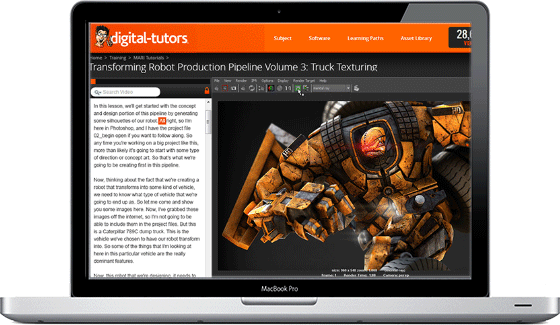
Digital Tutors creates video tutorials to teach visual effects for movie production and video game creation. Digital Tutors’ VOD subscription library contains more than 23,000 video tutorials ranging from game art to video editing to 3D animation. The video library is used by movie and game studios, art schools, and freelance artists looking to build their graphics and animation skills. A completely video based business, Digital Tutors allows students to customize their learning by focusing on specific skill sets and mastering software applications.
Motivation for Adding Captions and Transcripts to Video Tutorials
Piyush Patel, CEO of Digital Tutors, finds that the company uses interactive video transcripts and captions to enhance learning and to increase the value of their video tutorial subscription service. He explains that while accessibility is a requirement for Digital Tutor’s government and education customers, he finds the most value in the interactive transcripts. Mastering very technical skills such as video game animation or video illustration is no easy task. Transcripts make the videos searchable and keep his audience focused and engaged.
PIYUSH PATEL: “The content is very technical and to be able to search that content is a huge plus. So although we do have a small percentage of customers who are hearing impaired or challenged, the real motivation is that it makes our content much more searchable and rich. We found an additional value for [students who know] English as a second language. People that might be challenged in reading or hearing alone might now all of a sudden get that reinforcement. And again, it adds value.”
Scalable Captioning Workflow with the Help of 3Play Media
Captioning internally is a daunting, inefficient process. Patel had tried to implement captioning in-house. Ultimately he found that it was too difficult to keep up with Digital Tutor’s rapid pace of video production. Digital Tutors releases 8-10 new courses every day, and every cog in the production process must be scalable. Now with 3Play Media’s captioning and transcription process integrated with the rest of the video production process, the output is dependable and scalable.
PIYUSH PATEL: “We started this adventure seven or eight years ago. We bought foot pedals and software and hired people. But it’s just not scalable. So we abandoned that. We went to computer-based and hardware-based, and that didn’t work out well. So we’ve built a whole pipeline that takes our content, shrinks it down because the person transcribing it doesn’t need a huge video. That allows us to upload it to the servers, where you guys can pull it down and transcribe it. It’s all automated, so the minute it’s done, it gets fired back into our system, checked off. Transcript is available and off we go. We’ve built some pipelines in place to make that process very efficient and seamless for human interaction.”
Watch the recorded panel session “Strategies for Deploying Accessible Video Captioning”