Global audiences now expect localized content on day one, and traditional dubbing studios cannot scale fast enough to meet that demand. AI dubbing has moved from novelty to production-ready technology in under two years, reshaping how media companies, enterprises, and learning teams bring content to international markets. But the question arises:
What’s the difference between AI dubbing and traditional dubbing?
AI dubbing uses machine learning to automatically clone or synthesize voices, lip-sync, and translate content at scale with minimal human involvement. Traditional dubbing relies on human voice actors recording in studios, requiring significant time, coordination, and cost to produce localized content.
This guide is written for media and localization buyers who need to expand into new language markets without inflating budgets or sacrificing brand quality.
Ready to see AI dubbing in action on your own content? Request a 3Play Media AI dubbing demo to get a sample of your video localized in the languages you are targeting.
Key Takeaways
- AI dubbing is production-ready for most business and marketing content, while traditional dubbing still leads prestige film and character-driven creative.
- Hybrid workflows that combine AI generation with human linguistic review have become the dominant enterprise pattern.
- Compliance is tightening fast in 2026; buyers need vendors with clear consent, labeling, and data-residency practices.
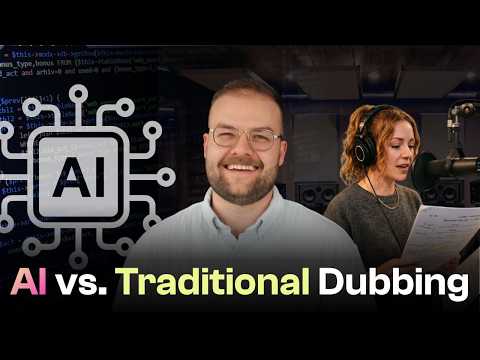
AI vs. Traditional Dubbing Video
What Is Traditional Dubbing?
Traditional dubbing is the process of replacing a video’s original dialogue with recorded performances in another language. It has been the gold standard of entertainment localization for more than 80 years, since Hollywood studios first began distributing “talkies” internationally.
A typical traditional dubbing project moves through five stages: script adaptation and linguistic QC, voice casting, studio recording with a voice director, editing and synchronization, and final mix and mastering.
Each stage involves specialized talent, including voice actors, directors, sound engineers, and localization project managers. Union projects add guild minimums and residuals to the cost stack.
Turnaround generally runs from two to eight weeks per language for most long-form content, and per-minute costs typically fall between $50 and $200 depending on talent tier, language, and studio market.
Traditional dubbing still wins for high-profile streaming originals, animated features, and any content where emotional performance is a core part of the product. Netflix, Disney, and major theatrical distributors continue to rely on it for flagship releases.
What Is AI Dubbing?
AI dubbing uses machine learning models to translate source dialogue and generate synthesized speech in the target language, often preserving the original speaker’s voice through cloning. Leading platforms can localize a 10-minute video into 20 languages in a minutes, at a small fraction of the cost of traditional workflows.
Modern AI dubbing pipelines combine several technologies. Understanding the pieces helps buyers evaluate vendor claims and design realistic QA processes.
ASR (Automatic Speech Recognition): The pipeline starts by transcribing the source audio. Word-level accuracy is critical because any transcription error will cascade through translation and speech generation. Enterprise-grade ASR models now routinely hit 95% accuracy or higher on clean audio.
Neural Machine Translation (NMT): The transcript is translated into each target language. Dubbing translation has unique requirements: it must match the rhythm and length of the original speech, not just the meaning. Specialized dubbing translation models optimize for syllable count and timing.
Text-to-Speech (TTS) and Voice Synthesis: Neural TTS generates the target-language audio. Quality has improved dramatically since 2023, with current models producing natural prosody, breath patterns, and emotional inflection that most listeners cannot reliably distinguish from human recordings in blind tests.
Voice Cloning and Voice Referencing: Voice cloning uses a short sample of the original speaker, sometimes as little as 30 seconds, to generate a speaker embedding that carries their vocal identity into the new language. This preserves brand continuity for CEOs, spokespeople, or recurring characters across dozens of localized versions.
Lip-Sync: Advanced pipelines re-render the speaker’s mouth shapes to match the new audio, producing video where the lips visibly form the new language.
Emotional and Prosody Transfer (XLPT): Cross-lingual prosody transfer, sometimes branded XLPT, carries the emphasis, pacing, and emotional tone of the original performance into the new language. This is the area where AI dubbing has closed the most ground against traditional workflows in the last 18 months.
AI dubbing already performs well for corporate training, e-learning, marketing video, news, sports highlights, podcasts, and social media content. It is increasingly viable for mid-tier entertainment as quality continues to climb.
Read our full breakdown of AI Dubbing.
Side-by-Side Comparison at a Glance
| Dimension | Traditional Dubbing | AI Dubbing |
|---|---|---|
| Cost per finished minute | $50 to $200+ | $1 to $20 |
| Turnaround per language | 2 to 8 weeks | Hours to 2 days |
| Languages in parallel | Limited by studio availability | Dozens simultaneously |
| Voice continuity across languages | Requires casting by language | Preserved via voice cloning |
| Emotional nuance | Industry-leading | Strong and improving rapidly |
| Lip-sync fidelity | Manual, high quality | Automated, variable quality |
| Human oversight | Director-led throughout | Optional, usually in QA step |
| Best-fit content | Flagship film, prestige streaming, character animation | Training, marketing, news, e-learning, social |
| Revision speed | Days, requires re-booking | Minutes, iterative |
| Compliance considerations | Standard talent contracts | Consent for voice cloning, synthetic media labeling |
Speed and Scale: Localizing at the Pace of Global Release
Traditional dubbing scales linearly. More languages means more studios, more directors, and more calendar time. Day-and-date global releases remain difficult even for tier-one streamers, and marketing campaigns with tight launch windows frequently miss international markets.
AI dubbing scales in parallel. A single source video can be processed into 30 languages simultaneously, with total turnaround measured in hours rather than weeks. This changes the economics of time-sensitive content categories.
News publishers can localize breaking coverage within the same news cycle. Sports leagues can push highlight reels to international fans while the match is still relevant. Marketing teams can launch global campaigns on the same day in every market.
Speed becomes the deciding factor for any content with a short shelf life, trending social video, and live or near-live event coverage.
Quality: Closing the Emotional Gap
The central critique of AI dubbing has always been emotional authenticity. Traditional dubbing still holds advantages in several areas: comedic timing, layered emotional performance, character-specific vocal identity, dialect authenticity, and the nuanced interplay between multiple speakers in a scene.
AI has caught up on voice naturalness, prosody, accent control, and multilingual voice cloning. Listener preference tests conducted by several platform vendors show that casual viewers rate modern AI dubs as acceptable to excellent for informational content, with preference gaps closing for scripted content as well.
Where AI still falls short: subtle comedy, layered emotional beats (think grief turning to resolve in a single line), regional dialect performance that signals class or origin, and multi-speaker overlapping dialogue.
Modern pipelines narrow the gap with three techniques. Cross-lingual prosody transfer preserves emphasis and pacing across languages. Speech-to-speech models bypass the transcription and translation steps to carry performance nuance directly. Director-in-the-loop tools let human reviewers adjust tone, pacing, and emotional delivery in the synthesized output.
QA workflows are what make AI-dubbed content enterprise-safe. The best-in-class pattern combines linguistic review of the translation itself, dialect or regional QA by in-market reviewers, sampling strategies that scale with content risk, and scorecards that track errors by category over time so the pipeline improves.
The Hybrid Model: AI + Human in the Loop
Most enterprise buyers end up here. A hybrid workflow preserves the economics of AI while retaining human judgment at the points that matter most.
A typical hybrid pipeline looks like this: AI generates a first draft translation and voice track, a linguistic reviewer checks the translation and flags issues, a language lead samples the audio for prosody and accuracy, selective re-records or post-edits happen for problem segments, and a final QA pass confirms technical compliance before delivery.
The tiering decision usually breaks down by content risk. AI-only is appropriate for internal training, high-volume e-learning modules, and evergreen marketing assets. Hybrid fits customer-facing content, multi-speaker interviews, podcasts, and moderate brand-risk marketing. Traditional still rules flagship creative, character animation, and any project with union or guild requirements.
This hybrid approach is exactly where 3Play Media’s AI dubbing service is built to deliver. We combine enterprise-grade AI voice generation with the professional linguistic review and QA that two decades of media localization work has taught us matters most.
Your content moves through AI generation for speed and cost efficiency, then our in-market language specialists validate accuracy, prosody, and cultural fit before anything reaches your audience. The result: AI-level economics with the quality assurance your brand requires.
Explore 3Play’s AI Dubbing SolutionsUse Cases by Industry
Streaming and Entertainment: Traditional dubbing leads for scripted prestige content. AI is gaining for unscripted, reality, documentary, and catalog tail content that was previously uneconomical to localize.
YouTube Creators: YouTube’s built-in auto-dubbing is a free starting point, but generic voices, flat prosody, and no human review push creators serious about retention and brand voice toward third-party vendors that offer voice cloning, professional QA, and editorial control.
Corporate Learning and Compliance Training: This is AI-first territory. Training content is high-volume, low brand-risk per asset, and frequently updated. AI dubbing makes it practical to maintain a fully localized global training library.
Marketing and Advertising: Hybrid is the sweet spot. Brand voice matters, but speed-to-market across regions is critical for campaign effectiveness. AI handles the bulk of the work; human review protects the brand.
News and Sports: AI-driven for speed. The value of the content decays in hours, so turnaround wins over emotional depth.
Gaming: Hybrid by tier. AI handles NPC and ambient dialogue; traditional or premium voice cloning covers lead characters and cinematic sequences.
EdTech, MOOCs, and Higher Education: AI-first with accessibility overlays. Courses localized with AI dubbing can be paired with captioning and audio description to meet accessibility mandates in multiple markets simultaneously.
Accessibility-Driven Dubbing: Dubbing itself is an accessibility feature for audiences with low literacy, learning differences, or visual impairment. AI dubbing lowers the cost of meeting these needs across language markets and dovetails with WCAG 2.2 guidance on accessible media.
Voice Cloning, Consent, and Creative Rights
Voice cloning works by generating a speaker embedding, essentially a numerical fingerprint of the speaker’s voice, from a reference sample.
That embedding conditions the text-to-speech model so the output carries the speaker’s identity in any supported language.
The talent-consent question is where responsible vendors diverge sharply from irresponsible ones. Licensed voice cloning follows a clear pattern: explicit written consent from the speaker, defined scope of use, compensation structure, and the ability to revoke the license and take the clone out of service.
SAG-AFTRA’s 2023 national TV/theatrical contract includes new provisions governing AI voice replication that set a useful industry baseline.
Brand voice continuity is a real operational win. A single voice clone of your CEO or lead spokesperson can carry brand identity consistently across 30 languages, something that was effectively impossible with traditional casting.
The flip side is that your voice asset library now needs governance: who authorized each clone, what scope they are licensed for, how long, and how usage is audited.
Compliance, Ethics, and Risk
Compliance pressure on synthetic media is tightening quickly through 2026, and buyers need vendors with clear answers.
The EU AI Act introduces transparency obligations for AI-generated content, with the provisions covering synthetic media labeling taking effect in August 2026. Any organization distributing AI-generated audio in the EU will need to disclose the synthetic nature of the content in a clear, machine-readable way.
China’s Cyberspace Administration (CAC) AI-generated content labeling rules took effect in September 2025 and require explicit labeling of AI-generated audio and video distributed in the Chinese market.
GDPR’s Article 9 provisions on special categories of personal data treat voice biometric data with extra care. Voice samples used for cloning should be processed with explicit consent, clear purpose limitation, and defined retention periods.
Accessibility compliance intersects with dubbing in ways buyers often overlook. The European Accessibility Act (EAA) took effect in June 2025 and expanded obligations for accessible media across EU member states.
Dubbing can support compliance by making content available to audiences who cannot easily read captions, but it has to coexist with captioning, audio description, and other accessibility features in a coherent workflow.
Internal governance matters as much as external compliance. Define who authorizes voice clones, how consent is captured and stored, where voice data is hosted, and how audit trails are maintained. Build these policies before you scale, not after.
Evaluating Vendors: What to Look For
When vetting AI dubbing vendors, focus on nine criteria:
- Language and dialect coverage relevant to your markets
- Voice-cloning quality plus a clean consent workflow
- Integration with your TMS, MAM, DAM, and caption or subtitle tooling
- Security posture including SOC 2 or ISO 27001 certification, data residency options, and encryption
- A review and editing workflow that your team can actually use (browser-based with approval routing is the current standard)
- QA and linguistic review support, whether in-house or through partners
- Transparent pricing with clear commitment tiers
- Services versus self-serve model (some buyers want a platform, some want a managed partner)
- A published roadmap that signals the vendor is keeping pace with the technology.
See our picks for the top eight AI dubbing tools.
A Decision Framework: Which Approach Is Right for Your Content?

The choice between AI, hybrid, and traditional is not a single organization-wide decision. Most enterprises segment their catalog and apply different tiers to different content types.
Use AI dubbing when content is high-volume, internal-facing or low brand-risk, time-sensitive, single-speaker, and frequently updated.
Internal training libraries, product marketing videos, and webinar recordings are strong candidates.
Use a hybrid workflow when content is customer-facing, multi-speaker, moderate brand-risk, and needs to reach 10 or more languages. Marketing campaigns, podcasts, educational content, and documentary work tend to land here.
Use traditional dubbing when content is flagship creative, emotionally complex, requires talent continuity with specific voices, or falls under union and guild requirements. Scripted entertainment, character animation, and high-profile original programming belong in this tier.
How to Pilot AI Dubbing Without Betting the Farm
Start with a low-risk content type. Internal training videos or evergreen product marketing are ideal pilot candidates because quality variance will not damage customer-facing brand perception.
Define success metrics upfront: cost per finished minute, turnaround time, linguistic accuracy rate on QA sampling, viewer retention on localized versus source content, and stakeholder approval scores. Running a parallel A/B comparison, taking the same content through both your traditional vendor and your AI vendor, produces the cleanest data.
Measure across five dimensions:
- Cost
- Time
- Linguistic accuracy
- Viewer retention or completion
- Stakeholder approval
Scale gradually and expand by content tier first (add higher-risk content as your QA matures), then by language count, then by format. Most enterprises can reach steady state in two to three quarters.
The Future of Dubbing: 2026 and Beyond
Real-time dubbing is maturing quickly, with live-event and video-conferencing applications already in production at several vendors. Interactive and personalized dubbing is emerging in gaming and adaptive learning, where content can be generated on demand for each user’s language preference.
Speech-to-speech models that preserve original performance without an intermediate text representation are closing the final gap with traditional dubbing on emotional nuance.
Voice-market economics are evolving in parallel. Synthetic voice libraries, royalty models for licensed voice clones, and marketplace dynamics for specialty voices are all actively developing.
Voice actors are increasingly finding roles as directors of synthetic performance, curating and coaching cloned voices rather than (or in addition to) recording every line themselves.
Ready to Test AI Dubbing on Your Content?
3Play Media’s AI dubbing pairs enterprise-grade AI voice generation and voice cloning with professional linguistic review across 70+ languages, giving you the economics of AI with quality safeguards your brand requires.
Flexible workflow tiering lets you match every content type to the right level of human oversight, from fully automated for high-volume internal content to hybrid human-reviewed for customer-facing assets, while native lip-sync, prosody transfer, and brand-voice continuity keep localized versions faithful to the original.
Because dubbing runs on the same platform that powers captioning, subtitling, transcription, and audio description, you can gain a single localization and accessibility workflow with unified security, integrations, and audit trails, so scaling into new markets does not mean stitching together new tools.
Meet with our team to set up a demo.
Ready to Give AI Dubbing a Try?
Meet with 3Play’s team to see how our dubbing translates to your video content.
AI vs. Traditional Dubbing FAQs
Is AI dubbing as good as traditional dubbing?
For most business content, educational material, news, and catalog entertainment, yes. For flagship scripted creative with complex emotional performance, traditional dubbing still holds an edge, though the gap is narrowing with each generation of speech-to-speech and XLPT models.
How much does AI dubbing cost per minute?
Pricing typically ranges from $1 to $20 per finished minute depending on voice tier, language, and whether human review is included. Traditional dubbing for the same content usually costs $50 to $200 per minute.
Can AI dubbing match lip movements?
Yes. Modern AI dubbing platforms can re-render mouth shapes (visemes) to match the new audio, producing video where the speaker’s lips visibly form the target language. Quality varies by platform and by source video complexity.
What’s the difference between AI dubbing and AI voiceover?
AI voiceover typically refers to generating a synthetic narration track, often from a script written directly in the target language. AI dubbing specifically replaces dialogue in existing video, which adds the complications of matching timing, emotion, speaker identity, and sometimes lip movement.
How do I choose between AI dubbing and traditional dubbing?
Segment your catalog by content tier. Apply AI to high-volume, low-risk content; hybrid to customer-facing content across many languages; and traditional to flagship creative. Pilot before you commit, and measure cost, quality, and audience reception in your specific context.
Filed under
About the author
Share this page