What is AI dubbing?
AI dubbing is the automated process of replacing a video’s original audio track with a translated, AI-generated voice in a new language, while preserving the original speaker’s voice characteristics, tone, and emotional delivery.
Global audiences don’t wait for translated content. The demand for multilingual video is accelerating faster than traditional dubbing studios can keep up with, and the economics of hiring voice actors for every language, every market, and every update no longer make sense for most businesses. AI dubbing changes the equation entirely.
Where traditional dubbing once required studio time, voice talent, and weeks of post-production, AI dubbing compresses that workflow into minutes.
A single video can be dubbed into dozens of languages simultaneously, with the original speaker’s voice cloned and reproduced across each one. The result is content that feels native to its audience without the cost and delay of conventional localization.
This guide covers everything you need to know about AI dubbing in 2026: how the technology works, what to look for in a platform, how it stacks up against traditional dubbing, and how to get started.
Learn about 3Play’s AI Dubbing solutions.
Key Takeaways
- AI dubbing uses machine learning to automatically transcribe, translate, clone voices, and sync audio to video, cutting production time from weeks to hours.
- Costs run as low as $2–$30 per minute compared to $50–$200 per minute for traditional studio dubbing, making global localization accessible at scale.
- The technology is maturing rapidly; 2026 platforms now produce broadcast-quality output, but human review remains best practice for cultural accuracy and nuance.
Table of Contents
- AI Dubbing Explained
- How AI Dubbing Works
- Key Features to Look for in AI Dubbing Tools
- AI Dubbing vs. Traditional Dubbing
- AI Dubbing Use Cases
- Benefits of AI Dubbing
- Challenges and Limitations of AI Dubbing
- How to Get Started with AI Dubbing
- AI Dubbing FAQs
AI Dubbing Explained
AI dubbing is the automated localization of video content into a new spoken language. Unlike subtitles, which display text on screen while the original audio plays, AI dubbing replaces the original audio entirely with a synthesized voice in the target language.
Unlike traditional voiceover, where a new voice actor simply reads a translation over the original, AI dubbing preserves the specific voice characteristics of the original speaker, including pitch, cadence, and emotional tone, and reproduces them in the new language.
Classical dubbing required a full studio operation: human translators, casting directors, voice actors, sound engineers, and editors working together to record, mix, and manually sync a new-language audio track to the on-screen lip movements of the original performers.
That process could take weeks and cost thousands of dollars per finished minute. AI dubbing automates every stage of that pipeline.
The technology has roots in early speech synthesis and machine translation research from the 1950s and 1960s, but it became practically viable only with the rise of deep learning in the 2010s.
Neural network architectures, particularly transformer-based models and diffusion models, unlocked the ability to clone voices, translate contextually, and synchronize audio to video with frame-level precision.
By 2026, platforms have closed much of the quality gap with human-produced dubbing for most content categories.
Users of AI dubbing span a wide range of industries and roles: independent content creators scaling their YouTube channels across language markets, enterprises localizing training and onboarding content for global teams, streaming platforms building out multilingual libraries, and many other use cases.
How AI Dubbing Works
The AI dubbing pipeline involves several coordinated stages, each powered by a different class of machine learning model.
1. Transcription. A speech-to-text AI converts the original audio into a written transcript. Modern automatic speech recognition (ASR) systems achieve high accuracy across accents, recording environments, and audio quality levels.
2. Translation. Natural language processing (NLP) models translate the transcript into the target language. This step goes beyond word-for-word conversion: advanced models handle idioms, cultural expressions, and context-dependent meaning. The best platforms allow human translators to review and edit this output before synthesis.
3. Text-to-Speech (TTS) Synthesis. An AI voice synthesis engine generates spoken audio in the target language using the translated script. Modern TTS systems produce natural-sounding speech with realistic pacing, intonation, and breath patterns.
4. Voice Cloning and Preservation. This is the feature that distinguishes AI dubbing from standard TTS. The system analyzes the original speaker’s voice characteristics (timbre, pitch range, speaking rhythm, and vocal texture) and maps those characteristics onto the synthesized speech in the new language. The result is that the dubbed audio sounds like the same person speaking a different language, not a generic AI voice.
5. Lip Sync. Frame-level analysis matches the new audio track to the on-screen mouth movements of the speaker. This is one of the most technically demanding aspects of AI dubbing and has historically been a weak point; 2026 platforms now achieve synchronization that holds up well on HD and 4K displays for most source/target language pairs.
6. Emotional Delivery. Emotion detection models analyze the original audio for affective cues: excitement, hesitation, sadness, warmth, sarcasm. Those cues are preserved in the synthesized output, so the dubbed version carries the same emotional tone as the original performance.
Key Features to Look for in AI Dubbing Tools
Not all AI dubbing platforms are equal. When evaluating tools for your workflow, these are the capabilities that matter most.
Language support. Leading platforms support a wide variety of languages and regional dialects. Check whether the platform covers the specific language pairs and accent variants your audience requires, not just headline language counts.
Voice cloning. The ability to clone and consistently reproduce a specific voice across all target languages is what makes AI dubbing feel cohesive. Look for platforms that offer both automatic voice cloning from your source content and the ability to build a persistent voice profile for ongoing use.
Lip sync accuracy. Frame-level synchronization that holds up at scale and across diverse language pairs is a differentiator. Request samples in your specific source and target language pair before committing to a platform.
Subtitle and transcript generation. The best platforms generate synchronized captions alongside dubbed audio in a single pass, so you get both a dubbed video and ready-to-publish subtitles from the same workflow.
Multi-speaker handling. If your content features interviews, roundtables, or ensemble casts, the platform needs to reliably identify and separately dub each voice without mixing up speakers.
Translation rules and brand consistency. Enterprise users need the ability to define terminology lists, brand voice guidelines, and translation rules that are enforced across every piece of content in every language.
API integration. Programmatic access enables AI dubbing to slot into existing content management and distribution workflows without manual file uploads and downloads.
Why 3Play Media Checks Every Box
3Play Media’s AI dubbing solution was built with all of the above in mind, and it’s purpose-built for creators and teams who are serious about global reach.
The platform combines AI efficiency with human expertise: every dub goes through human-verified scripting, culturally adapted dialogue, and a final review by global language professionals, so you’re not just getting a machine translation pushed out the door.
Try 3Play’s AI-Enabled DubbingAI Dubbing vs. Traditional Dubbing
For most content teams, the choice between AI and traditional dubbing comes down to volume, budget, timeline, and the creative demands of the specific project.
| Factor | AI Dubbing | Traditional Dubbing |
|---|---|---|
| Cost | ~$2–$30/minute | ~$50–$200/minute |
| Turnaround | Minutes to hours | Days to weeks |
| Scale | Unlimited, simultaneous languages | Linear, one language at a time |
| Voice consistency | High (same voice, all languages) | Variable (different actors per language) |
| Emotional depth | Strong for most content; gaps in nuanced performance | Highest ceiling for emotional complexity |
| Cultural adaptation | AI handles idioms; may miss deep cultural nuance | Human actors and directors can fully adapt |
Choose AI dubbing for corporate training videos, e-learning modules, social media content, product demos, marketing campaigns at scale, and any high-volume localization project where turnaround and cost efficiency are primary constraints.
Choose traditional dubbing for premium film and television productions, content where deep emotional performance is central to the work, and projects with strict creative control requirements where a director wants to shape every performance.
The hybrid approach is increasingly the industry standard. AI handles the first-pass efficiency: transcription, translation, voice synthesis, and lip sync. Human reviewers, including translators, voice directors, and native speakers, then polish the cultural and emotional dimensions of the output. This model captures the cost and speed advantages of AI while preserving the creative ceiling of human expertise.
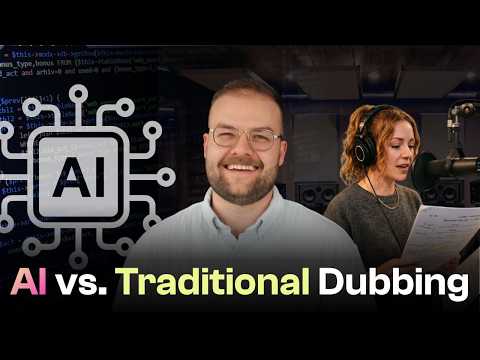
Read the full breakdown of AI vs traditional dubbing.
AI Dubbing Use Cases
Content Creators and YouTubers
AI dubbing lets individual creators distribute their content to non-English audiences without re-recording anything. A creator with a strong English-language following can publish the same video in Spanish, Portuguese, French, and Japanese simultaneously, maintaining their own voice across every version.
YouTube’s own research has documented the correlation between multilingual availability and channel growth in global markets.
Learn more about AI dubbing for YouTube.
E-Learning and Corporate Training
Learning and development teams face a persistent challenge: how do you keep training content current across a workforce that spans dozens of countries and languages?
AI dubbing makes it feasible to localize an entire LMS library and update it continuously as policies and procedures change. Compliance training, onboarding modules, and skills development content can all be dubbed into local languages at a fraction of the traditional cost.
Marketing and Advertising
Brand voice is one of the hardest things to localize well. AI dubbing with voice cloning allows marketing teams to carry the same spokesperson, tone, and energy into regional markets without sourcing local voice talent for every campaign. Product demos, brand videos, and digital ad content can be adapted for new markets in the same production cycle.
Film and Entertainment
For independent filmmakers and streaming platforms, traditional dubbing costs have long been a barrier to international distribution. AI dubbing brings theatrical-quality localization within reach for projects that wouldn’t otherwise have had access to it. Streaming services are increasingly using AI-assisted dubbing to expand the multilingual availability of their libraries.
Podcasts and Webinars
Recorded and live audio content can be distributed in multiple languages from a single original recording. Webinar recordings, in particular, benefit from AI dubbing because they tend to be long-form content with a single primary speaker, which is well-suited to current voice cloning capabilities.
Benefits of AI Dubbing
The benefits of AI dubbing include:
- Cost savings: AI dubbing can reduce localization costs by up to 90% compared to traditional studio dubbing. The $2–$30 per minute range for AI-assisted dubbing against the $50–$200 per minute range for traditional production represents a structural shift in what’s economically viable.
- Speed: Content that previously required weeks to localize can be dubbed in hours. This makes it possible to publish multilingual versions of time-sensitive content simultaneously with the original.
- Global reach: Language is the primary barrier to international audience growth. AI dubbing removes that barrier at a cost and speed that allows organizations of any size to compete in global markets.
- Voice consistency: With voice cloning, a brand spokesperson or course narrator sounds like the same person in every language. That consistency strengthens recognition and trust across markets.
- Scalability: A content library of hundreds or thousands of videos can be dubbed into ten or more languages in parallel, rather than sequentially. The economics of dubbing at library scale are fundamentally different with AI.
- Accessibility: Content that was previously available only in one or two languages can now reach language communities that have historically been underserved by localized content.
- Workflow integration: Cloud-based AI dubbing platforms are designed to fit into existing production pipelines via API, making integration with content management systems and distribution platforms straightforward.
Challenges and Limitations of AI Dubbing
AI dubbing has improved dramatically, but understanding its current limitations is essential for making good production decisions. Challenges include:
- Lip sync imperfections: Synchronization challenges are most pronounced when the source and target languages have different phonetic rhythms and word lengths. English-to-German dubbing, for example, often requires more audio time per sentence in German, which can create visible mismatches that require manual correction.
- Emotional nuance: For most content, AI-generated emotional delivery is convincing. For premium narrative content, the subtlest cues remain difficult to reproduce reliably: the slight catch in a voice, the pause that signals grief rather than hesitation. Human finishing is still recommended for content where emotional precision is critical.
- Translation accuracy: Idiomatic expressions, cultural references, and context-dependent meaning remain challenging for automated translation. A phrase that lands perfectly in one cultural context can be confusing or even offensive in another if translated literally.
- Accent and dialect authenticity: Regional dialects and hyper-local linguistic expressions may be flattened into a more generic version of the target language. For content where regional authenticity matters, this is worth evaluating carefully.
- Over-reliance without review: Publishing AI-dubbed content without a native speaker review is the most consequential practical limitation. Automated workflows can produce plausible-sounding mistranslations that a native reviewer would catch immediately. Human review is not optional for professional-grade output.
How to Get Started with AI Dubbing
Step 1: Define your goal. What content are you dubbing, into which languages, and for what audience? A short product demo for a single new market is a very different use case from dubbing an entire learning library for a global enterprise rollout. Clarity on scope shapes every subsequent decision.
Step 2: Choose the right tool. Match platform capabilities to your specific requirements. Key variables include language coverage, voice cloning fidelity, lip sync accuracy, multi-speaker support, editing tools, and API availability.
Step 3: Prepare your source content. Source audio quality has a direct impact on AI output quality. Clean audio with minimal background noise, clear diction, and consistent levels produces significantly better results than noisy or mixed-down source files. If you’re recording new content specifically for dubbing, speak at a measured pace and avoid heavy background music that competes with the voice track.
Step 4: Run a test dub. Before committing a full content library, test the platform on a 2-3 minute clip that’s representative of your typical content. Evaluate lip sync quality, voice fidelity, translation accuracy, and emotional delivery against your specific source and target language pair.
Step 5: Review and refine. Build native-speaker review into your workflow before publishing. A fluent reviewer can catch translation errors, unnatural phrasing, and cultural missteps that would be invisible to an English-only team. These services are included in 3Play’s AI dubbing solutions.
Pro tips: Avoid heavy background music in source files; it competes with voice isolation. Speak clearly and at a moderate pace in source recordings. Use a platform with subtitle export to repurpose dubbed audio as captions for the same content, so a single dubbing pass produces both a dubbed video and accessible captions.
Conclusion
AI dubbing has moved from experimental technology to a production-ready tool that is reshaping how content teams think about global distribution. The cost and speed advantages are decisive for most use cases: hours instead of weeks, dollars instead of hundreds of dollars per minute, and simultaneous multilingual publishing where sequential localization was once the only option.
The quality gap that once made AI dubbing unsuitable for professional content has largely closed for standard content categories. The remaining challenges, primarily around deep emotional nuance and cultural adaptation, are best addressed through hybrid workflows that combine AI efficiency with human expertise.
The organizations building AI dubbing into their content workflows now are developing a compounding advantage. Each piece of content published in a new language builds audience, SEO presence, and brand recognition in that market. Teams that establish these capabilities today will be measurably ahead of those who wait.
3Play Media makes that starting point straightforward. The platform brings together AI-powered dubbing and human language review in a single workflow, so you get the speed of automation without sacrificing the cultural accuracy that audiences notice.
Whether you’re a creator testing your first non-English market or an enterprise localizing a full content library, 3Play Media’s tiered dubbing service scales to match your goals, with voice cloning, native-language voice options, and delivery directly to YouTube all included.
AI Dubbing FAQs
Can AI do dubbing?
Yes. AI can handle the full dubbing pipeline: transcribing the original audio, translating the script, synthesizing a voice in the target language, cloning the original speaker’s vocal characteristics, and syncing the new audio to on-screen lip movements.
How is AI dubbing different from subtitles?
Subtitles display translated text on screen while the original audio continues to play; AI dubbing replaces the audio entirely with a synthesized voice in the target language. The result feels more natural for audiences who prefer to watch without reading.
Is AI dubbing as good as traditional dubbing?
For most content categories, including e-learning, marketing, corporate video, and social media, AI dubbing now produces broadcast-quality results. Premium narrative content, where emotional performance is central to the work, can still benefit from human voice actors handling the final layer of production.
How accurate is AI dubbing translation?
AI translation handles standard language conversion, including common idioms and context-dependent phrasing, reliably for most content. Hyper-local cultural references, regional slang, and highly nuanced language can still require human review to ensure accuracy and cultural appropriateness.
Can AI dubbing clone my voice?
Yes. Most leading platforms offer voice cloning that analyzes your original audio and reproduces your pitch, tone, and cadence in the target language. The result is a dubbed version that sounds like you speaking a different language rather than a generic AI voice.